





How credit unions can modernize their brand, website, and digital experience for Gen Z and new members while continuing to serve the members who built the institution
Credit unions have something many digital-first financial brands spend enormous amounts of money trying to create: trust.
They have established relationships. They understand their communities. Their unique proximity to their members often allows them to have a stronger sense of purpose and member ownership than traditional financial institutions. This strong community-based focus brings generations of members together around shared values, creating relationships that extend far beyond an app or website.
But the way people experience that relationship is changing. The definition of community is changing. Together, they create an evolving dynamic that credit unions need to understand and make a board-level priority.
For new members, it’s likely their first interaction with a credit union may not be a conversation with a branch employee. It may be a Google search, AI Search, an Instagram post, a mobile website, a TFSA calculator, an online application, or a fully remote banking account creation. Each of these experiences needs to be augmented with a “human touch,” a person who is helping guide a new member after they’ve had some form of digital interaction.
That means the brand is no longer experienced primarily through a branch, a brochure, or a conversation with a representative.
The digital experience is the brand. Your people are the brand. Both are true.
But the reality is that, as a whole, Gen Z starts with digital and leans on digital forms of communication. It’s irrefutable that Credit Unions must acquire new Gen Z members to protect the long-term health of their organizations. The challenge is: how do you attract Gen Z members without isolating the long-standing members who’ve been loyal for 10, 20, or 30 years?
The answer is not to build a completely different credit union for tech-savvy people.
It is to build a more adaptable credit union that can serve different members in different ways.
1. Start with the member, not the technology
Modernization should begin with a clear understanding of the people a credit union serves, how they can service them in the future, and how their expectations, needs, and behaviours are changing.
A credit union may serve a student opening their first account, a young professional saving for a home, a family managing multiple financial products, a business owner looking for financing, and a long-standing member who values familiar ways of banking.
They are all members of the same institution, but they may have very different goals, levels of digital confidence, and expectations from the experience and how they would like or need to interact with their financial institution.
The question, then, is not as simple as:
How do we make our digital experience more modern?
It is:
How can we create an experience that feels relevant to each member, even if they are 20 years apart, while remaining consistent in the value we provide?
That starts with understanding the moments that matter across the member relationship: from discovering the credit union and opening an account to borrowing, investing, managing day-to-day finances, and getting support.
Some members may want to complete everything digitally and independently. Others may want guidance before making a financial decision. Some will expect a mobile-first experience, while others may continue to prefer a combination of digital, phone, and branch interactions.
The goal is not to force every member into the same journey.
The goal is to create a flexible experience that adapts to different member needs while maintaining a consistent brand, a cohesive relationship, and the same high standard of service across every interaction.
This is where modernization becomes more than a website redesign. It becomes an opportunity to rethink how the credit union serves members across generations — and how digital experiences can complement the human relationships that remain at the heart of the credit union model.
Launching a digital banking platform is often treated as standard IT: select, configure, and launch. But for credit unions, members don't experience project plans - they experience journeys. To de-risk your launch, stop asking 'Does the platform support this feature?' and start asking 'Can a real member complete this task from start to finish?' Read our 7-step playbook to unlock more value after go-live.

The distinction is important.
A credit union does not need to abandon its identity to become digitally relevant.
It needs to translate that identity into digital experiences that people understand and want to use.
2. Design Digital Experiences Around Member Needs
One of the biggest mistakes in digital experience design is assuming that every visitor should follow the same path;
- A 19-year-old opening their first checking account has different questions from a 52-year-old refinancing a mortgage.
- A small-business owner has different priorities from a retiree checking their investment portfolio.
- An existing member who has banked with the institution for 25 years should not necessarily be treated like someone visiting for the first time.
The answer is not to create dozens of disconnected websites.
It is to create adaptive journeys within one coherent experience. For example:
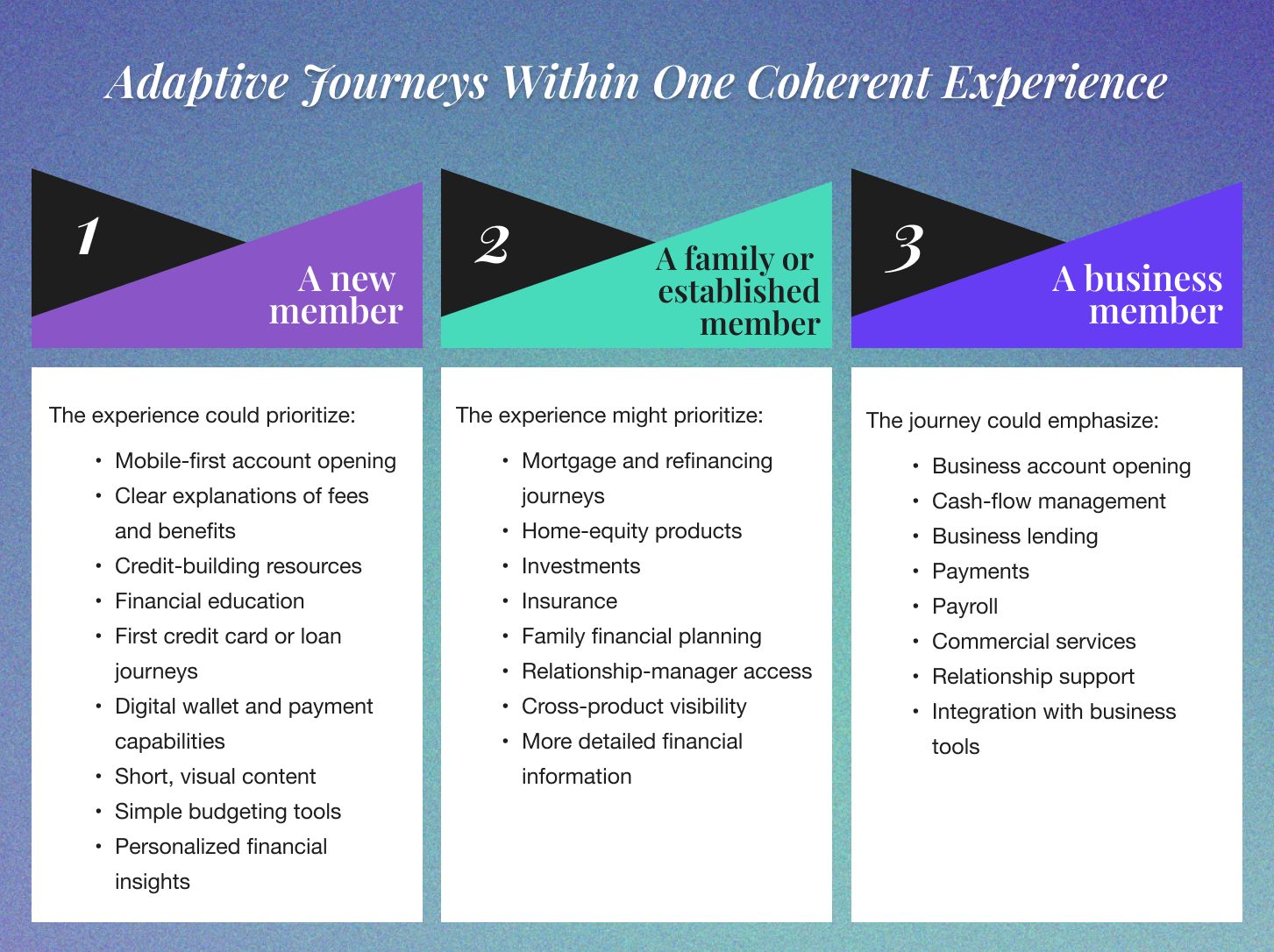
The underlying brand remains the same. The navigation, content, calls-to-action, and supporting information simply become more relevant to the person in front of you.
Resist the urge to put everything on your homepage, but make sure it's all easy to find and categorized according to your customers' needs and expectations. As each member self-identifies their needs, guide them along their financial journey.

This is where UX research, analytics, and journey mapping become critical.
Before redesigning screens, credit unions should identify the highest-value member journeys and understand where people currently drop off, hesitate, call for help, or abandon a task.
3. Modern does not mean “designed for Gen Z”
A modern credit union experience starts with more than a refreshed visual identity. A new colour palette, updated typography, or contemporary photography can change how a brand is perceived, but they are only one part of the transformation.
What matters is how the entire experience comes together.
Can a prospective member quickly understand what the credit union offers? Can an existing member find what they need without navigating through layers of information? Can someone opening their first account complete the process without unnecessary steps? Can a member move seamlessly between the website, mobile experience, digital banking, chat experiences, and human support?
These are the interactions that shape how modern an organization feels.
For new members in particular, digital experiences are often the first point of contact with a financial institution. But the same principles benefit members of every generation: clarity, simplicity, consistency, and ease of use.
A modern experience should make it easier to:
- Understand products and services
- Identify the credit union’s core values, mission, and principles
- Find relevant information quickly
- Navigate between related journeys
- Complete important tasks with fewer unnecessary steps
- Move easily between desktop and mobile
- Access preferred support models when needed
- Understand what happens next
- Interact with the credit union in a consistent way across channels
The visual design still matters. It communicates who the credit union is and creates an immediate sense of relevance and credibility.
But a contemporary-looking interface cannot compensate for a complicated journey.
The strongest modernization efforts bring brand and experience together — creating a credit union that looks current, feels intuitive and works the way members expect.
Your brand is more than a colour scheme, it's a consistent voice and style throughout your site, your branches, everywhere. But your brand should enhance the user experience, not overwhelm it. The customer isn't there because of your brand!
4. Build Workflows Around the Member, Not the Process
An adaptive digital experience becomes especially valuable when it is applied to workflows — the actual steps a member takes to accomplish something. A credit union may have a single account-opening process defined internally, but that does not mean every member should experience the same journey.
There is a significant difference between:
“You recently viewed our first-time homebuyer guide. Here are three resources that may help.”
and:
“We noticed you have been looking at homes in this neighbourhood.”
The first can feel helpful. The second can feel intrusive. Personalization therefore needs a clear value exchange.
Members should understand why they are seeing something and how it helps them.
Content platforms can support this by creating audience-specific experiences based on factors such as device, location, behaviour, or defined personas. dotCMS, for example, supports persona-driven content targeting and rules-based personalization while separating content from the presentation layer.
The technology is important. It enables the experience members are experiencing in other areas of their lives.
But the trust model is even more important.
With the proliferation of financial institutions used by Gen Z, trust is the currency to win or lose wallet-share. Understanding what matters to them and what life stage they are in is a critical step in winning their trust.

For credit unions, this can become a competitive advantage. Their relationship with members already gives them a foundation of trust. The digital experience needs to respect the trust a member has in them.
Consider two people opening a new account.
A first-time member may need to:
- Understand the different account options
- Confirm eligibility
- Compare products
- Complete digital identity verification
- Provide funding information
- Understand what happens next
An existing member, however, may already have much of this information and verification on file. Their journey could be significantly simpler:
- Sign in
- Select a new product
- Review pre-filled information
- Confirm eligibility
- Provide any missing details
- Complete the application
These are not simply two versions of the same workflow. They reflect different levels of familiarity, different needs, and different relationships with the credit union.
The opportunity for credit unions is to design workflows that adapt to the member and the context, rather than forcing everyone through the same sequence of steps.
This does not mean creating a separate digital experience for every member. It means identifying where member needs genuinely differ and using technology to respond accordingly – through pre-filled information, progressive forms, relevant content, saved journeys, personalized calls to action, or a seamless transition to human support when needed.
A connected, personalized member journey is critical. It helps each member feel known and understood, which is key for building trust. Trust is the currency that helps Credit Unions differentiate themselves.
Workflows begin with intent, and that intent should also shape how a credit union organizes its public website.
Many credit union websites are structured around internal organizational categories such as Personal Banking, Business Banking, Products, Resources, Services, and About Us. These labels may accurately reflect how the organization operates, but they do not necessarily reflect how members think.
Members rarely arrive at a website thinking in terms of organizational structures. They arrive with a goal/need:
- I want to buy my first home.
- I need to open an account.
- I want to improve my credit.
- I need to send money.
- I want to understand my mortgage options.
- I need financing for my business.
- I can’t find my statement.
A modern information architecture should help a member start with that intent and naturally move toward the right product, service, information, or action.
For example, a member thinking “I’m buying a home” (first-time homebuyer journey) might move through:

The navigation itself does not need to become entirely life-stage based. Instead, credit unions can create multiple paths into the same underlying content and services — connecting member types, life moments, financial goals, products, tasks, education, and support in ways that make sense to the user.
This is particularly important as credit unions serve increasingly diverse generations and member segments. A first-time homebuyer may need education and reassurance, while an experienced homeowner may be looking for a rate or a faster path to refinancing. Both may ultimately need the same mortgage product, but their paths to that product should not necessarily be identical.
Another example of an effective, adaptive workflow is a guided journey for members opening their first Tax-Free Savings Account (TFSA). Rather than directing them straight to a product page or application form, the credit union can anticipate their questions and provide the right information and support at every step.
A member who is new to TFSAs may want to understand how the account works, what types of savings or investments it can support, how contribution limits work, and whether it suits their financial goals. The digital journey can guide them through the basics, explain important considerations in plain language, help them explore available options, and then lead them to the account-opening process when they are ready.
For an existing member who already understands TFSAs, the journey can be much shorter. They may simply want to review the available options, confirm eligibility, and open an account through a streamlined application with relevant information pre-filled where possible.
Both members have the same goal, opening a TFSA, but they may need different levels of guidance to get there.
By connecting educational content, product information, personalized calls to action, and digital banking functionality, credit unions can create a journey that supports members from initial interest to completion without unnecessary friction. The result is an experience that helps members make informed decisions while making it easier to take the next step when they are ready.
The goal, therefore, is not to find one “perfect” navigation model. It is to build an information architecture that reflects actual member behaviour and can evolve as those behaviours change.
That requires using member research, search behaviour, analytics, usability testing, and ongoing feedback to understand how people actually look for information, rather than assuming they will navigate the site according to the credit union’s internal structure.
5. Treat the website as a living product
One of the biggest differences between modern digital organizations and traditional website programs is how they think about the website.
A traditional approach is:

A modern approach is:

The website becomes an ongoing product. That means marketing teams should be able to update content without waiting weeks for development resources:
- They should be able to test different messages.
- They should be able to create landing pages.
- They should be able to update campaigns.
- They should be able to personalize experiences.
- They should be able to respond to changing member needs.
A headless or composable CMS can help separate the content layer from the front-end experience, allowing organizations to deliver content through different channels and frameworks while maintaining centralized governance. dotCMS describes this model as combining headless flexibility with visual editing and structured content management.
A member cares about their experience; they don’t think in terms of channels. They think about their long-term goals or a specific task they want to resolve. A headless CMS gives Credit Unions the flexibility to evolve their experience and meet the member needs, regardless of the channel.
This is especially valuable for credit unions with lean marketing and technology teams.
Modernization should reduce dependency – not simply move the dependency somewhere else and should not be an attempt to make a “75-year-old credit union” look like a fintech startup.
6. Connect the website and digital banking experience
A beautiful website cannot compensate for a disconnected digital banking experience.
A member might discover a mortgage product on the website, click “Get Started,” enter digital banking and suddenly encounter a completely different interface:
- Different navigation.
- Different language.
- Different branding.
- Different terminology.
- Different account information.
- Different authentication.
That transition creates friction, but from the member’s perspective, it is still one credit union.
They do not care which vendor owns which layer. They expect the experience to connect.
A modern architecture can separate the experience layer from the systems underneath it while connecting those systems through APIs and integration services.
A simplified architecture might look like:
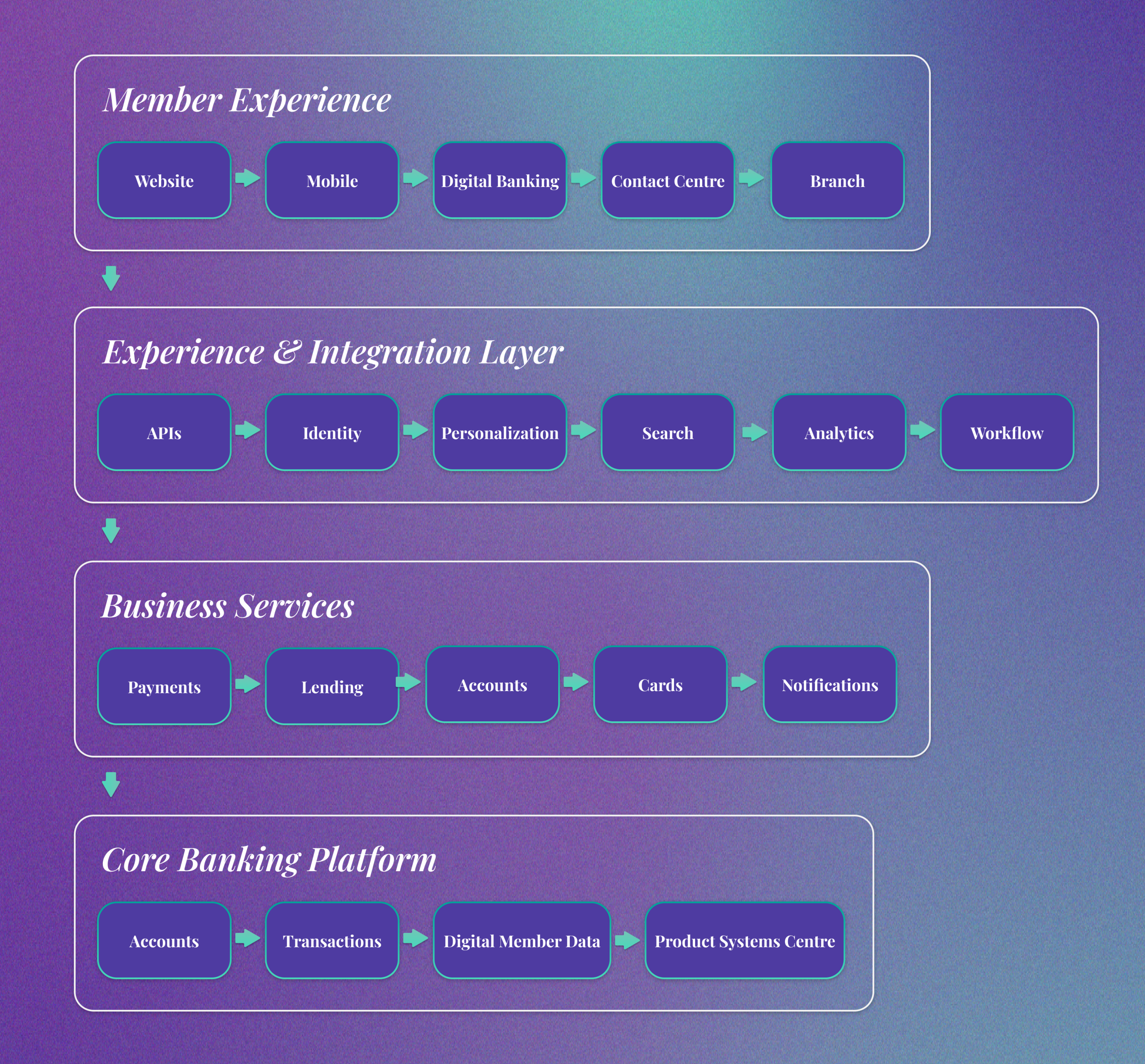
This separation allows credit unions to modernize the member experience without necessarily replacing every underlying system at the same time.
Aequilibrium’s recent work on digital banking modernization similarly emphasizes member-centric design, API-first architecture, incremental modernization and the importance of understanding dependencies on core banking systems.
Members experience one credit union, even when several systems sit behind it. Our role is to connect those systems so the relationship feels continuous: from discovering a product to completing an application or speaking with an advisor. That starts with a clear roadmap: improve the journeys that matter most, integrate what already works, and modernize in manageable steps.
7. Design for continuity between digital and human service
Modernization should not mean eliminating the human relationship.
In fact, the opposite can be true.
Digital should handle the simple things exceptionally well so employees can spend more time helping members with complex things.
If a member can easily:
- Check a balance
- Update information
- Open an account
- Transfer funds
- Find a document
- Understand a product
- Start an application
then branch and contact-centre teams can spend more time on:
- Financial planning
- Complex lending
- Business needs
- Major life decisions
- Financial education
- Relationship building
The digital channel becomes an extension of member service rather than a replacement for it.
We don't build digital tools to minimize human connection; we build them to elevate it. By automating the routine tasks, we empower credit union staff to deliver the kind of deep, personalized guidance that algorithms simply can't match.

For new members, that can also change the perception of what a credit union is.
Digital convenience gets them through the door.
Human expertise gives them a reason to Trust.
The Credit Union experience provides them a reason to stay.
8. Design for Every Member. Build for Continuous Improvement.
It’s more than connecting the online and offline. It’s about elevating how we engage every member.
Designing solely for the 'ideal user' leaves too many members behind. True digital modernization means incorporating accessibility into your design system from the very beginning. Ultimately, inclusive design is just good design.
A connected experience is only valuable when members can navigate it with confidence, find the information they need, and trust what they see. Achieving this requires a deliberate approach to how digital experiences are designed, maintained, and improved over time.
Three elements deserve particular attention:
- Accessibility: Design for the full spectrum of member needs, from different abilities and levels of digital literacy to varying devices and connectivity. Inclusive experiences should be an integral part of modernization, not an afterthought.
- Design systems: Look beyond individual pages and consider the underlying system that connects them. Reusable components, shared patterns, and structured content help maintain consistency while allowing digital experiences to evolve as member expectations change.
- Built-in guardrails: Establish principles and standards that help keep content accurate, interactions predictable, and experiences aligned with the credit union’s service commitments. Trust is shaped by every digital interaction, not just the most visible ones.
The opportunity lies in bringing these elements together into a cohesive approach. When accessibility, consistency, and trust are considered from the beginning, credit unions can create digital experiences that are easier to use today and better prepared for tomorrow.
9. Measure experiences, not just traffic
A modern website should be judged based on deepening member engagement and acquiring new members. Not page views.
The more important questions are:
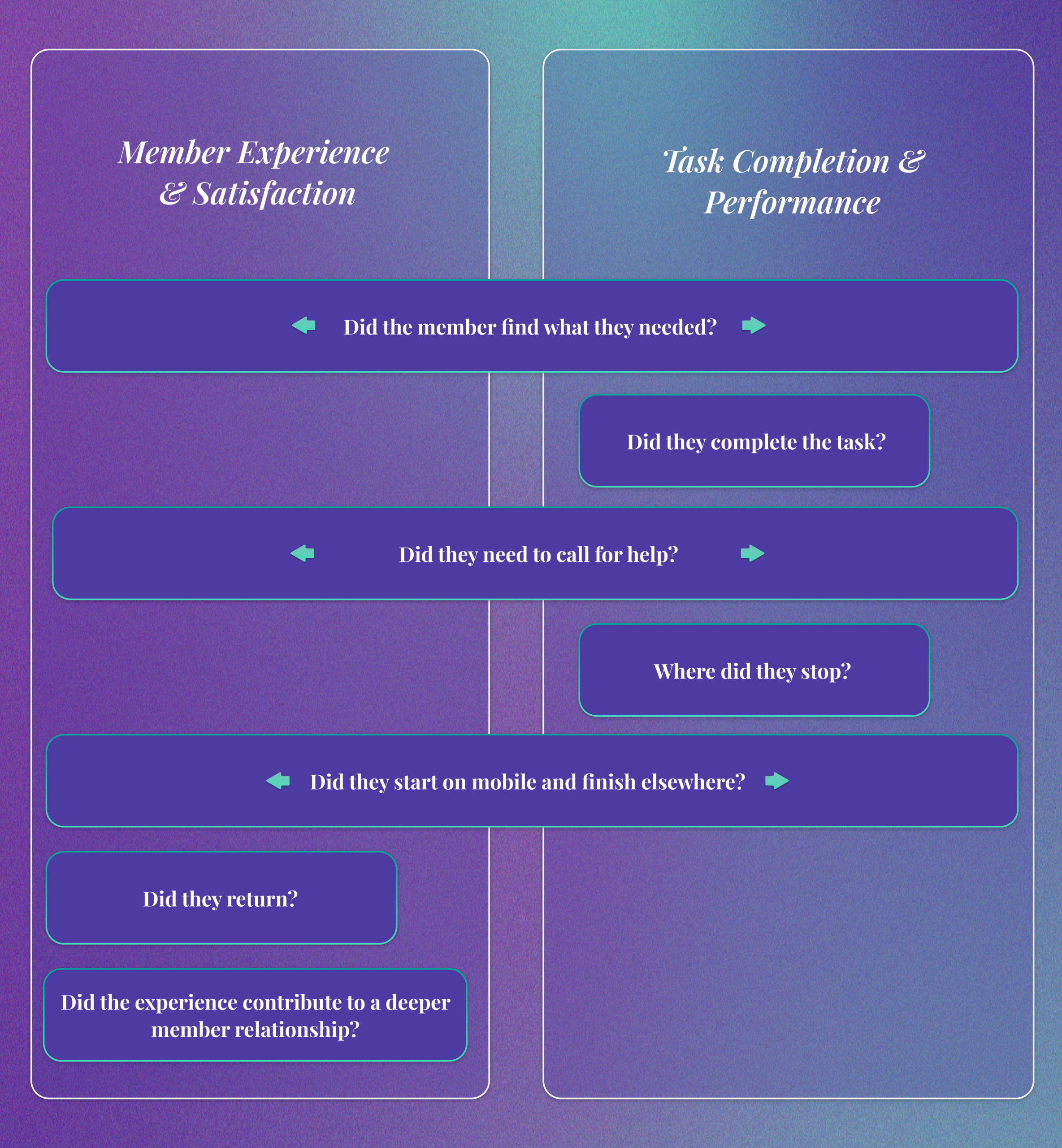
Useful measures could include:
- Account-opening completion
- Digital onboarding completion
- Mortgage application starts and completions
- Search success
- Application abandonment
- Mobile task completion
- Self-service adoption
- Contact-centre deflection
- Member satisfaction
- Content engagement
- Conversion by member segment
- Digital product adoption
This changes the conversation from:
“Do we like the new website?”
to:
“Is the new experience helping members accomplish more?”
10. Use AI carefully - where it improves the experience
AI can add another layer to modernization.
But credit unions should resist adding AI simply because competitors are doing it.
The precursor to any use of AI is governance. AI should be treated as an “employee”, with additional precautions. It must have guardrails, audit trails, and, most importantly, a human in the loop. From there, Credit Unions should identify useful applications, which could include:
- Conversational search
- Financial education
- Content recommendations
- Personalized insights
- Customer-service assistance
- Internal employee support
- Content creation
- Content governance
- Search optimization
- Application assistance
The key is to identify where AI removes friction.
For example:
A member should not have to understand the difference between five mortgage products before they can find relevant information.
An intelligent assistant could ask a few simple questions and guide them toward appropriate information, while clearly communicating when a human advisor should become involved.
AI should therefore be treated as part of the experience architecture, not as a standalone feature.
The Future of the Credit Union Is Not Younger. It Is More Relevant.
The next generation of credit union experiences will not necessarily be defined by having more digital features. They will be defined by how well the institution adapts.
Adaptive experiences can respond to:
- Member type
- Intent
- Device
- Context
- Previous interactions
- Product ownership
- Location
- Behaviour
- Accessibility needs
But adaptation should happen within a consistent brand and governance framework. This is where composable technology becomes particularly relevant.
A modular architecture makes it possible to change individual parts of the experience without rebuilding the entire system. The question credit unions face is not:
“How do we make our institution appeal to Gen Z?”
It is:
“How do we make our institution relevant to the next generation while continuing to deliver the trust and value for existing members?”
The answer will not be a new colour palette.
It will not be a redesigned homepage.
It will not be a new mobile app by itself.
And it will not be a single technology implementation.
It will be an ecosystem where brand, content, UX, public website, digital banking, core banking, data, AI and human advice services work together.
Modernization should make the credit union easier to understand, easier to navigate, easier to join and easier to do business with,while making the organization more capable of adapting as member needs change.
Aequilibrium + dotCMS: Building a Connected Member Experience
Modernizing a credit union’s digital experience requires more than selecting a new website platform or content management system. It requires a connected approach to brand strategy, user experience, content, digital banking, integrations, and the underlying technology that brings everything together.
Aequilibrium brings expertise in digital transformation, financial services, member experience, and digital banking modernization. Its approach combines member-centric design with practical modernization strategies, helping credit unions improve digital experiences while connecting front-end journeys with the banking platforms and systems that support them.
dotCMS provides a flexible content management foundation that enables organizations to structure and reuse content, support personalization, empower teams through visual editing, and deliver consistent experiences across digital channels — all while maintaining appropriate governance and control.
Together, Aequilibrium and dotCMS can help credit unions bring these capabilities together to create digital experiences that are not only more intuitive today, but also easier to adapt as member expectations, business priorities, and technology continue to evolve.
The goal is not simply to build a more modern website. It is to create a connected member experience that reflects the credit union’s values, supports its business strategy, and makes it easier for members to get what they need at every stage of their financial journey.
Ready to Rethink Your Credit Union’s Digital Experience?
Modernizing your website is an opportunity to do more than refresh your brand. It’s a chance to create more intuitive member journeys, connect content and digital services, and build an experience that evolves with your members.
Let’s explore how Aequilibrium and dotCMS can help your credit union turn that vision into reality.
