





Launching a digital banking platform is often treated as standard IT: select, configure, and launch. But for credit unions, members don't experience project plans - they experience journeys. To de-risk your launch, stop asking 'Does the platform support this feature?' and start asking 'Can a real member complete this task from start to finish?' Read our 7-step playbook to unlock more value after go-live.

Launching a new digital banking platform is often approached as a technology implementation: select the platform, configure the capabilities, connect the integrations, test the solution, and go live.
For credit unions, however, the platform is only one part of the transformation.
A new digital banking platform can fundamentally change how members interact with their credit union – from discovering products and logging in to managing accounts, completing transactions, getting support, and moving between digital channels. At the same time, the implementation can reshape the technology ecosystem behind those experiences, including integrations, data flows, content management, authentication, analytics, internal processes, and support operations.
The platform is the foundation. The member experience is the outcome.
That distinction is critical. A platform can be delivered on schedule, meet its technical requirements and successfully go live, yet still leave members navigating confusing journeys, inconsistent content, disconnected experiences or gaps between systems. Internal teams may also find themselves managing a more complex environment without the governance, processes or specialized expertise needed to get the most value from the investment.
The real opportunity is therefore not simply to replace an existing digital banking platform. It is to use the transition to simplify the technology landscape, improve the member experience, strengthen organizational readiness, and create a foundation for continuous innovation.
That requires thinking beyond the implementation plan and considering the full transformation, from the first member interaction through migration, launch, and ongoing optimization.
The following seven steps provide a practical playbook for credit unions looking to reduce implementation risk, prepare their organization for a successful launch, and unlock more value from their digital banking investment long after go-live.
Initial Assessment: Perform a Gap Analysis Before the Implementation Accelerates
Before focusing on configuration and delivery milestones, establish a clear understanding of where the new environment may differ from the current one.
A digital banking platform does not operate in isolation. Credit unions typically have a network of third-party systems supporting core banking, cards, payments, account opening, CRM, identity, documents, analytics, member support, and other functions.
The risk is not only whether each individual system works.
The important question is whether the new platform and its supporting ecosystem can collectively support the journeys, functionality, and operational processes that members and employees rely on today and what needs to change for tomorrow.
A structured gap analysis should identify:
- Functional gaps between the existing digital banking environment and the new platform
- Differences in capabilities across existing and new third-party systems
- Integration dependencies and potential points of failure
- Features that may require configuration, customization, or an alternative approach
- Data dependencies and migration considerations
- Impacts on member and employee journeys
- Capabilities that may be lost, delayed, or materially changed during the transition
- Operational and support implications
- Areas where additional testing or mitigation will be required
The objective is not simply to produce a list of gaps.
It is to create a risk mitigation strategy.
For each significant gap, establish what will happen, who owns it, when it needs to be resolved, and how the credit union will validate that the solution works.
This creates visibility before gaps become launch-blocking issues.
What to ask
- What can members do today that they will not be able to do in the new environment?
- Which existing integrations need to be rebuilt, replaced, or redesigned?
- Are there differences between the capabilities of the current and future third-party systems?
- Which gaps affect critical member journeys?
- Which gaps can be addressed before launch, and which require a post-launch roadmap?
- What assumptions about existing functionality need to be validated?
The outcome: a documented gap and risk register that connects technology decisions to member, operational, and business impacts.
1. Start With the Member Journey, Not the Platform Plan
A digital banking implementation naturally creates a technology-centric project plan:

But members do not experience the project plan.
They experience journeys.
A member may start by searching for the credit union online, arrive on the public website, explore a product, log into digital banking, check an account, transfer money, manage a card, apply for a product, or contact member support. To the member, these are not separate technology components; they are parts of a single relationship with their credit union.
Behind the scenes, however, that experience may span multiple platforms, integrations, teams, and third-party providers.
That disconnect is where many implementation risks emerge.
A digital banking platform may perform exactly as designed, while the overall member journey remains fragmented. A hand-off between the public website and authenticated experience may be confusing. A critical piece of information may not carry across systems. A member may complete one step successfully but have no clear path to the next.
Journey mapping brings these gaps into view before they become launch-day problems.
Map Critical Journeys End to End
Start by identifying the journeys that matter most to members and to the credit union. These may include:
- Finding and comparing products
- Opening or applying for an account
- Onboarding a new member / Registering for digital banking
- Logging in and recovering access
- Viewing balances and transactions
- Moving money and paying bills
- Managing cards
- Updating personal information
- Accessing statements and documents
- Getting help or resolving an issue
- Completing a service request
Then map each journey from the first interaction through completion.
For example, a product journey may begin on Google, continue through the public website, move into an application experience, require authentication or identity verification, and ultimately result in an account appearing within digital banking.
Look closely at every transition:
- Where does the journey begin?
- What information does the member need at each step?
- Where does authentication occur?
- When does the member move between systems?
- Does the experience remain consistent across those transitions?
- What data needs to move between platforms?
- What happens when an integration fails?
- Where does the member go if they need help?
- Can employees see enough context to support the member?
Mapping these journeys exposes dependencies and friction that can easily be missed when each platform or integration is assessed independently.
Design Around the Moments That Matter
Not every journey requires the same level of attention. Focus first on experiences that are:
- High volume
- High value to the member or credit union
- Operationally or technically complex
- Critical to onboarding
- Frequently supported by member contact centre or branch teams
- Dependent on multiple systems or third parties
- Likely to create significant friction if something goes wrong
This prioritization helps teams focus limited implementation and testing resources where they can have the greatest impact.
It also changes the way requirements are validated.
Instead of asking only, “Does the platform support this capability?”, ask:
“Can the member successfully complete the entire task?”
That difference is important. A technically complete feature is not necessarily a successful member experience.
The goal is to ensure the new digital banking environment supports the complete member journey, not simply a collection of platform requirements.
The outcome: an end-to-end experience map that becomes a shared reference point for platform configuration, integration planning, UX, testing, migration, communications, and post-launch optimization.
2. Treat the Digital Banking Platform and Website/CMS as One Experience
Multiple digital platforms can also mean multiple vendors.
The institution may be paying separate contracts for mobile development, digital banking platforms, analytics, identity services, integrations, support, and other capabilities.
Each relationship creates its own:
- Contract management requirements
- Service-level agreements
- Product roadmaps
- Support processes
- Integration dependencies
- Renewal cycles
- Negotiations
Following a merger, consolidating these relationships can create meaningful operational efficiencies.
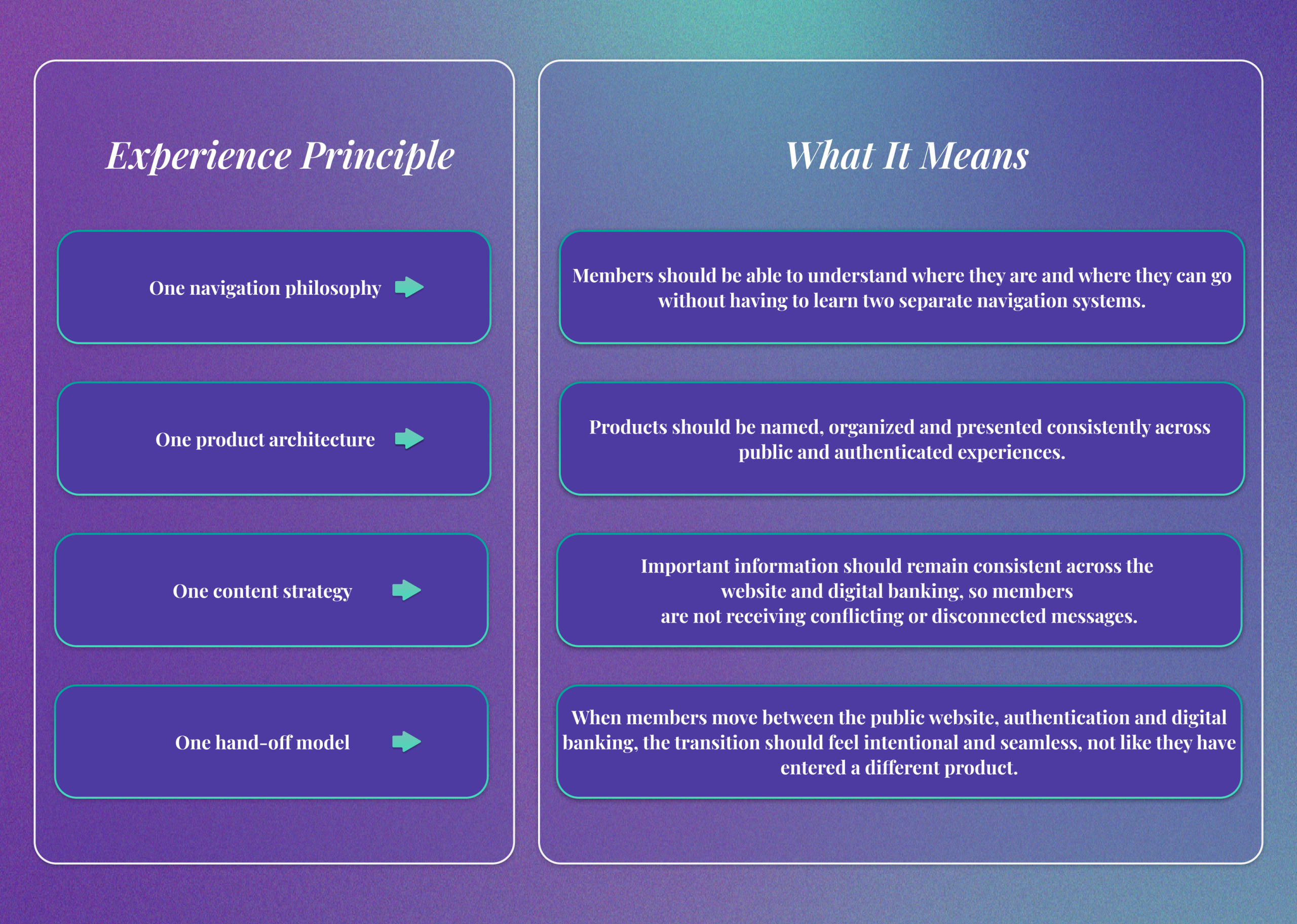
Establish a shared experience framework
Before launch, define:
Don't overlook the CMS
The content management system is not simply a place to publish web pages.
It can become an important part of the member experience after launch.
Credit unions need the ability to update content, respond to member questions, support campaigns, communicate changes and continuously improve journeys without depending on a major technology release for every adjustment.
A well-defined CMS and governance model can therefore reduce operational friction long after implementation is complete.
The outcome: a consistent experience and operating model that connects the public website, authenticated banking environment and supporting content.
3. Rationalize the Integration Landscape Early
The digital banking platform may be the most visible component of the transformation, but it is only one part of the technology ecosystem that supports the member experience.
Behind every balance displayed, payment initiated, card managed, or document accessed are systems working together – core banking, CRM, cards, payments, account opening, identity, document management, analytics, fraud and security services, and a range of third-party applications.
Each connection introduces a dependency. And each dependency can become a source of complexity, disruption, or unexpected effort during implementation.
That is why integration planning should begin well before development and testing, not as a technical exercise at the end of the implementation, but as a strategic assessment of the ecosystem that supports the member experience.
Move Beyond an Integration Inventory
An integration inventory tells you what connects to what. Rationalization asks a more important question: “Does every integration still need to exist in its current form?”
For each integration, evaluate:
- What business capability does it support?
- Which member or employee journeys depend on it?
- What data does it provide or consume?
- How critical is it to day-to-day operations?
- What happens if the integration fails or becomes unavailable?
- Is the integration still required in the future-state environment?
- Is functionality duplicated elsewhere?
- Could the integration be simplified, consolidated, or retired?
- Does it introduce constraints for future products, experiences or capabilities?
This assessment becomes particularly important when replacing an existing digital banking environment.
A common approach is to replicate the existing integration landscape in the new platform. While this may appear to reduce change, it can also carry unnecessary complexity, outdated dependencies, and technical debt into the new environment.
A new platform creates an opportunity to step back and determine which integrations are essential, which need to change, and which may no longer be necessary.
2. Member Experience Suffers
The technology costs are always significant, but the member experience may be even more important.
A merger creates an expectation of greater value.
Members expect a stronger institution, broader capabilities, better service, simplifications, new features, and a more seamless relationship overall with their credit union.
A fragmented digital experience sends the opposite message.
Branding Confusion
Imagine a member receives communication announcing that two credit unions have become one.
They download the new mobile app or open the existing one and discover that the experience looks substantially different depending on which organization they came from.
Different colors, navigation patterns, terminology, icons, or even different brand treatments can create confusion if communication and application changes are not aligned.
A rebrand does not automatically create a unified digital experience.
The digital product has to reflect the new organization and the promises shared as part of the merger value.
Prioritize Critical Dependencies
Not every integration carries the same level of business or member impact.
Prioritize the dependencies that support critical capabilities such as:
- Authentication and identity
- Account and transaction data
- Payments and transfers
- Card management
- Account opening and onboarding
- Member profile data
- Documents and statements
- Fraud and security
- Notifications and communications
- Analytics and reporting
For each critical dependency, establish clear ownership, technical requirements, testing scenarios, monitoring, and contingency plans.
This is also where third-party coordination becomes important. The credit union may depend on multiple vendors, each with its own release cycles, technical constraints, and responsibilities. Without clear ownership across the ecosystem, an issue that appears to be a platform problem can quickly become a coordination problem.
Build for the Future State, Not Just Day One
Integration decisions made during implementation can shape the credit union’s ability to evolve the digital experience for years.
The goal should not be to recreate the existing architecture exactly as it is today. Instead, use the transition to establish a simpler, more resilient, and more flexible integration landscape—one that supports the immediate launch while creating room for future capabilities.
The outcome: a prioritized integration strategy with clear dependencies, ownership, and risk mitigation plans, designed to support both a smoother launch and a more adaptable digital banking environment after go-live.
4. Put Personalization Architecture in Place Before Launch
Personalization is often treated as something to address after the new platform is live.
That can be a missed opportunity.
A new digital banking environment creates an opportunity to rethink how member data can support more relevant experiences. But personalization works best when the underlying data, segmentation, and governance decisions are established early.
Before launch, determine where specific data should live, what data should influence the member experience.
For example:
- Member segment
- Products held
- Recent activity
- Life-stage indicators where appropriately available
- Digital engagement
- Service interactions
- Product eligibility
- Journey stage
- Previous interactions
- Relevant preferences
Then determine what that data should actually do.
Could it influence:
- Content?
- Product recommendations?
- Offers?
- Alerts?
- Next-best actions?
- Education?
- Onboarding?
- Support experiences?
Start with useful personalization
Personalization does not need to mean complex AI-driven recommendations on day one.
It can begin with simple, meaningful differences in the experience.
A new member may need onboarding guidance.
A member with a mortgage may need relevant servicing information.
A business member may need access to different capabilities and resources.
A member who rarely uses digital banking may benefit from education or simplified guidance.
The important part is to define the architecture and governance early so that personalization can evolve rather than become another disconnected initiative.
Establish the rules
Before launch, clarify:
- What data can be used?
- Where does the data come from?
- Is the data accessible?
- Can new platforms and systems such as AI agents connect to the data?
- Who owns it?
- How frequently is the data updated?
- What permissions or privacy considerations apply?
- Which teams can create or change segments within the data?
- How will personalization be measured?
The outcome: a foundation for relevant, measurable personalization that can expand after launch.
5. Test With Real Member Tasks, Not Just Requirements
A requirement can be technically satisfied while the member experience still falls short.
Consider a simple requirement: members can transfer money.
A functional test can confirm that the transfer capability works. But completing a real transfer involves much more.
- Can the member find the transfer function?
- Do they understand the terminology?
- Is the process intuitive on mobile?
- Do they know what information to enter?
- What happens if they make a mistake?
- Is the confirmation clear?
- What happens if the transaction fails?
- Can the member understand what went wrong, and what to do next?
- Can an employee or member contact centre representative help them resolve the issue?
Testing should validate the complete task, not just the individual feature.
This is particularly important during a digital banking launch, where multiple systems, channels, and teams come together for the first time. A problem may not exist within the platform itself; it may occur at the hand-off between systems, within a communication, or when an employee needs to support a member through an unfamiliar process.
Combine Multiple Layers of Testing
A launch-ready testing strategy should bring together several perspectives:
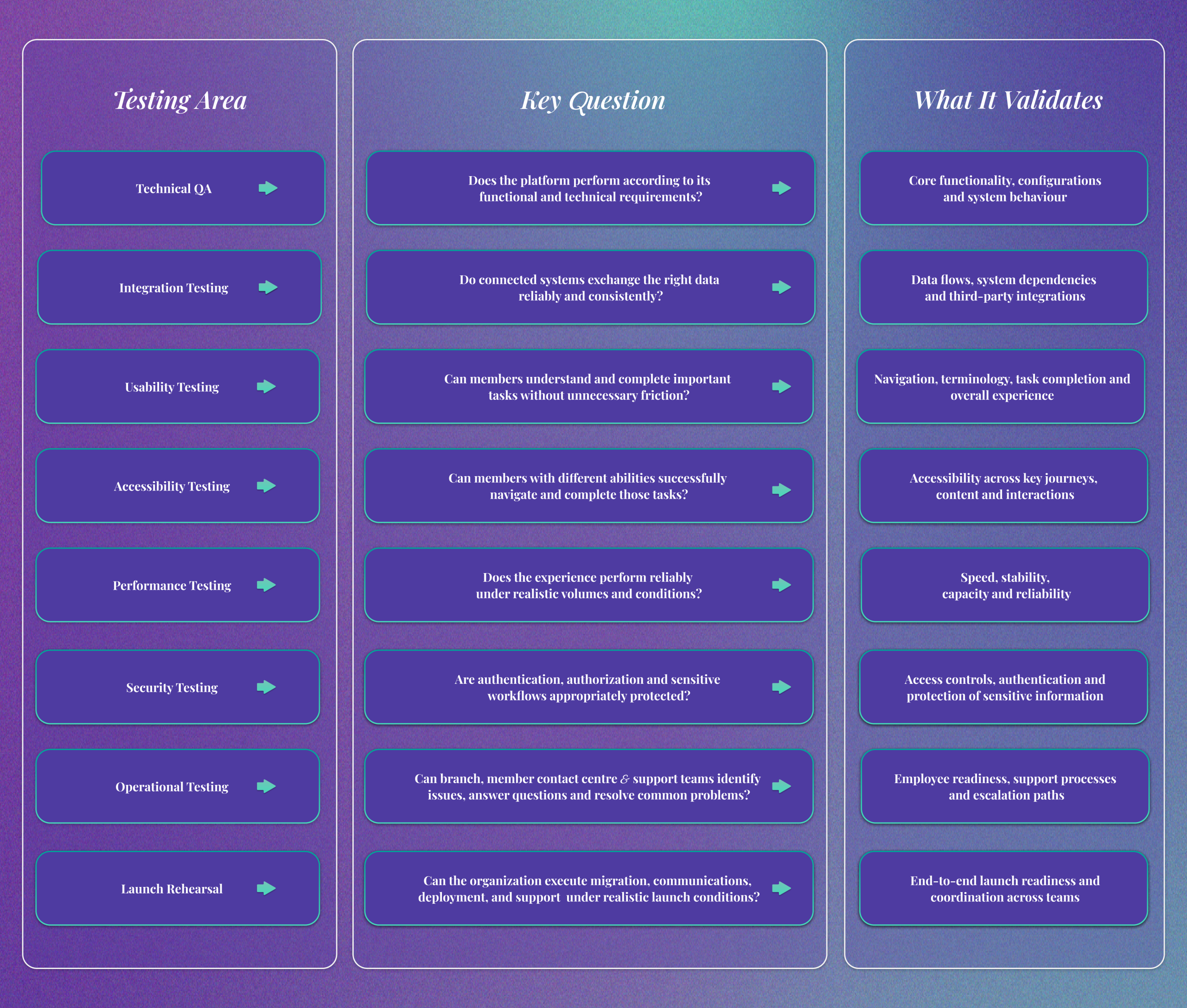
These layers should not operate independently. Testing should connect the technology, member experience, and operational model so that the organization can evaluate what happens when a member attempts to complete a task from beginning to end.
Test the Unhappy Paths
Real members do not always follow the ideal path.
They forget passwords. Enter incorrect information. Use an unfamiliar device. Lose connectivity. Abandon a transaction. Encounter an error. Or simply do not understand what the system is asking them to do.
These scenarios deserve as much attention as the standard successful flow.
Test situations such as:
- Forgotten or reset passwords
- Failed authentication or MFA
- Locked accounts
- Incorrect information
- Interrupted or failed transactions
- Expired sessions
- Unsupported or unexpected devices
- Failed integrations
- Missing or delayed data
- Accessibility-related challenges
- Members who need additional assistance
- Employees handling escalated issues
The objective is not to eliminate every possible issue before launch. That is rarely realistic.
The objective is to understand where failures can occur, determine their potential impact, establish clear recovery paths, and ensure that both members and employees know what to do when something does go wrong.
Test the Experience, Not Just the Technology
The strongest testing programs bring together technology teams, business stakeholders, UX teams, operations, and frontline employees around the same question:
Can a real member successfully complete this task from start to finish?
That question provides a much stronger measure of launch readiness than a list of requirements marked “passed.”
The outcome: greater confidence that the digital banking experience works not only in controlled technical conditions, but in the real-world situations members and employees will encounter after go-live.
6. Design Migration and Communications as a Product

For members, launch day is not a technology milestone.
It is a change to how they access and use their money.
That makes migration a product experience in its own right.
The first login may be the first interaction a member has with the new environment. If that experience is confusing, the credit union may see a spike in calls, abandoned registrations, and negative feedback before the new platform has had a chance to demonstrate its value.
Design the first-login experience
Think through the complete transition:
- What does the member need to know before launch?
- What credentials will they use?
- Will passwords change?
- Is MFA changing?
- What does registration involve?
- What happens with joint accounts?
- How are business members affected?
- What happens to saved information?
- Where are statements and documents?
- What features have changed?
- Where can members get help?
Then design communications around those moments.
Segment the communication
Different members may require different information. Consider segments such as:
- Highly active digital users
- Members who rarely use digital banking
- Channels members interact with most must have communication alignment
- Business members
- Older members
- Members with multiple products
- Members using specialized digital features
- New members
- Members likely to need additional support
Communication should not simply announce the new platform.
It should answer the practical question: “What do I need to do, what will be different for me, and how will I get help if I need it?”
Prepare the organization too
Member-facing communication is only one side of migration readiness.
Contact centre teams, branch employees and other frontline staff need:
- Training
- FAQs
- Troubleshooting guides
- Escalation procedures
- Clear ownership
- Visibility into known issues
- A way to capture recurring member feedback
If hundreds of members report the same issue, the organization should be able to recognize the pattern and respond quickly.
The outcome: a coordinated migration experience that supports both members and employees through the transition.
7. Measure and Optimize Immediately After Launch
Go-live is not the finish line.
It is the beginning of the optimization phase.
The first weeks after launch provide some of the most valuable information available about how members actually interact with the new environment.
That means credit unions should establish their measurement framework before launch, not after problems begin appearing.
Monitor the complete digital experience
Relevant signals can include:
- Digital adoption
- Registration and login completion
- Funnel abandonment
- Search behaviour
- Navigation patterns
- Feature usage
- Mobile and web analytics
- Member Contact centre themes
- Support volumes
- App store reviews
- Member feedback
- Accessibility issues
- Performance
- Error rates
- Heat maps and session behaviour where appropriately implemented
No single metric tells the whole story.
A sudden increase in member contact centre calls might indicate a technical issue, but it could also reveal confusing language, poor navigation or an unclear migration message.
Likewise, low feature adoption does not necessarily mean members do not want the feature. They may simply be unable to find it or understand how to use it.
Create a launch optimization rhythm
Establish a regular process for reviewing:
- What members are doing
- What members are saying
- Where they are experiencing friction
- What employees are hearing
- Which issues have the greatest member impact
- What can be fixed quickly
- What requires a larger product or technology change
Then prioritize improvements based on evidence. Some changes may be as simple as updating content or navigation.
Others may require UX improvements, integration changes, additional configuration, or a broader product roadmap.
The key is to avoid allowing the new platform to become a static implementation.
The outcome: a continuous improvement model that turns post-launch data into measurable experience improvements.
Bringing It All Together: Who Owns What?
A successful digital banking transformation depends on clear roles.
The digital banking platform partner brings deep expertise in the platform, product capabilities and technology required to deliver the new environment.
The credit union brings the member knowledge, business priorities, organizational context, and strategic direction.
But there is often another layer of work required between the two:
Turning the platform into a successful transformation for the credit union.
This can include:
- CU-side program management
- Gap and fit analysis
- Member journey mapping
- Experience and CMS strategy
- Integration and third-party coordination
- Requirements and validation
- Testing strategy
- Migration readiness
- Rollout and employee training
- Governance
- Analytics
- Post-launch optimization
This is where an experienced transformation partner can complement the platform implementation.
A complementary partnership model
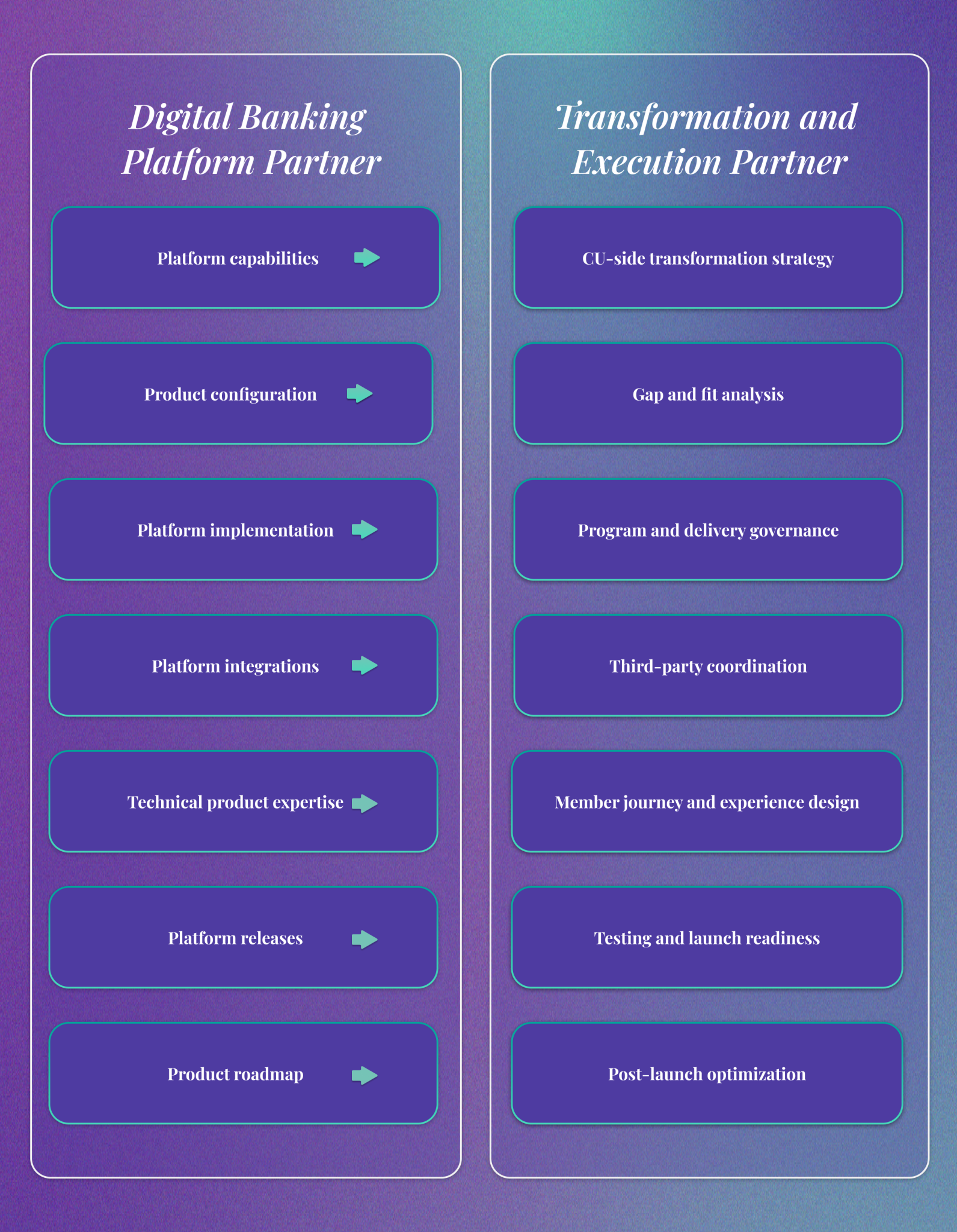
The roles are complementary rather than competing.
The objective is to ensure the credit union is not simply implementing a new technology platform, but building the capabilities, experiences and operating model needed to get sustained value from it.
The Real Measure of a Successful Launch
A digital banking launch should not be measured simply by whether the platform went live on time.
Go-live is a milestone, not the finish line.
The more meaningful measures of success emerge when members and employees begin using the new experience in the real world:
- Can members complete their most important tasks easily and confidently?
- Can employees and member contact centre teams support them effectively?
- Do the public website and authenticated banking experience feel like one connected experience?
- Are integrations stable, well understood, and manageable?
- Is the credit union using data to create more relevant and useful member experiences?
- Can internal teams make changes and improvements without unnecessary dependencies?
- Is there a clear process for identifying friction, prioritizing improvements, and acting on member feedback?
These questions shift the focus from “Did we launch?” to “Are we delivering the experience and value we set out to create?”
A digital banking platform provides the foundation. The real value comes from how effectively the credit union builds on that foundation: connecting technology, member experience, data, people, and processes into an environment that can continue to evolve.
By identifying gaps early, designing around complete member journeys, rationalizing integrations, establishing a foundation for personalization, testing real-world tasks, treating migration as an experience, and measuring what happens after launch, credit unions can reduce implementation risk while creating a stronger foundation for long-term digital growth.
Ready to De-Risk Your Digital Banking Transformation?
The right platform is only one part of a successful digital banking transformation. Credit unions also need the right strategy, governance, experience design, testing, rollout support, and post-launch optimization to turn implementation into measurable member value.
Aequilibrium works alongside credit unions to bridge the gap between platform implementation and successful transformation – from gap analysis and member journeys to integration, launch readiness, and continuous optimization.
Let’s talk about how to prepare your digital banking transformation for a successful launch and create more value after go-live.
